

Hand Sewing Needles – Small Tool, Big Job
The Wednesday Stitch - 30th SEPTEMBER 2026 Hand Sewing Needles – Small Tool, Big Job
A hand-sewing needle looks like one of the simplest tools in the sewing room.
But change the point, the eye, the length or the thickness, and suddenly that little needle can feel completely different in your hand.
That’s why one needle can glide beautifully through fabric while another feels awkward, drags the thread or makes the job harder than it needs to be.
This week, we’re taking a closer look at hand-sewing needles — what the different shapes and sizes actually mean, which ones suit different types of stitching, and how to recognise when the needle itself might be causing the problem.
Because sometimes it isn’t your hands, your eyesight or your stitching.
Sometimes you simply need a different needle.
https://everythingfabric.com.au/collections/hand-sewing-needles
WHAT ACTUALLY CHANGES FROM ONE NEEDLE TO ANOTHER?
The Point
Sharp point: needs to pierce the fabric.
Used for embroidery, appliqué, sashiko and general hand stitching.
Blunt/rounded point: intended to move between the threads of an open-weave fabric rather than pierce them.
That's why tapestry/cross-stitch needles feel so different.
The Eye
The eye needs to be big enough for the thread to pass through without rubbing and shredding it.
But enormous isn't necessarily better either. If the needle and eye are much larger than needed, you're making a larger path through your fabric every time.
Choose the needle for the thread as well as the fabric.
The Thickness
Fine fabric and fine thread generally call for a finer needle.
Heavy thread, multiple strands, dense fabric or several layers may need something stronger.
The Length
This is especially important with sashiko.
A longer needle lets a sashiko stitcher load several stitches onto the needle. Clover specifically makes both regular and long sashiko needles, and their sashiko needles are designed with sharp points, smooth plating and eyes intended to make threading easier.
But some people simply control a shorter needle better.
Neither is wrong.
The Finish
The finish of a needle can also affect how it feels as it passes through the fabric.
Some needles are manufactured and polished to create an exceptionally smooth surface; Tulip Hiroshima, for example, describes its fine embroidery needles as polished for smooth passage through the fabric, while Clover uses nickel plating on its sashiko needles.
Sometimes you notice the difference. Sometimes your favourite needle turns out to be the inexpensive one. Your fingers are allowed to decide.
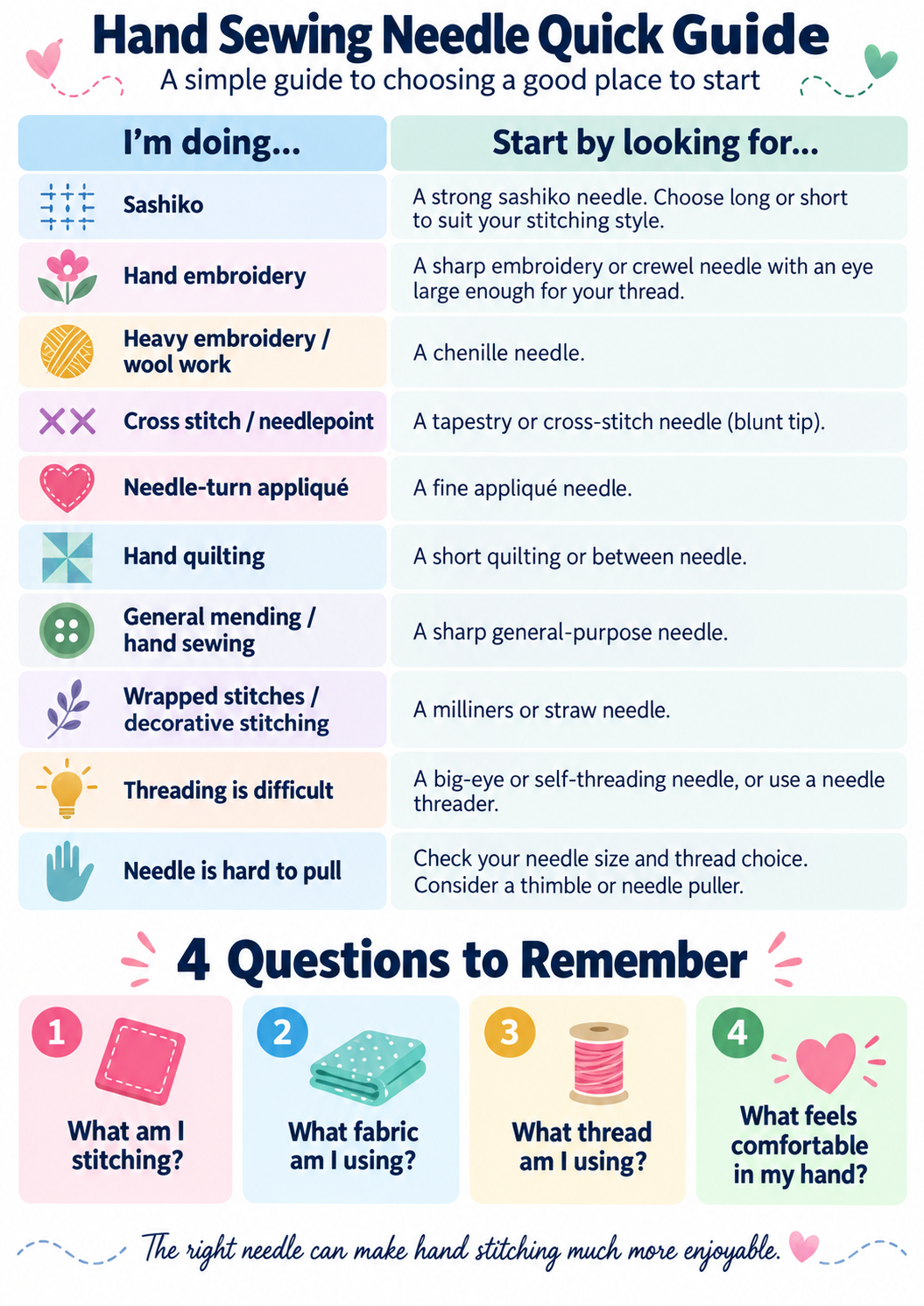
WHAT DO ALL THOSE NEEDLE NAMES MEAN?
Sashiko Needles
What makes them useful: strong enough for sashiko thread and the repeated running-stitch motion, with lengths suited to different styles of stitching.
COSMO Hidamari Sashiko Assorted Needle Set
- Clover Sashiko Needles – 8 Pack
- Clover Long Sashiko Needles – 3 Pack
- Emmacreation Sashiko Needles – Long & Short 2 Pack
- Olympus Sashiko Needles Assorted Sizes – 4 Pack
- Tulip Hiroshima Sashiko Needles – Assorted Long
- Tulip Hiroshima Sashiko Needles – Assorted Short
EMBROIDERY / CREWEL NEEDLES
Sharp point + an eye designed to take embroidery threads.
Good for:
- stranded embroidery floss
- surface embroidery
- decorative stitching
- slow stitching
- many stitchery projects
We have Bohin Embroidery/Crewel needles, SOHMO Japanese-made Crewel Needles and the Tulip Hiroshima embroidery range, including finer and thicker options. The SOHMO needle, for example, has a sharp point and a long eye designed to accommodate multiple strands of embroidery floss.
Learning Curve
If you're constantly fighting to pull the thread through the eye, don't automatically blame your eyesight.
The eye may simply be too small for your thread.
And if the thread is being rubbed fuzzy right beside the needle, that's telling us something too.
CHENILLE NEEDLES — When Your Thread Needs a Little More Room
Chenille needles have:
- a sharp point
- a large eye
- a stronger, heavier feel than fine embroidery needles
Useful for:
- heavier embroidery threads
- wool embroidery
- wool appliqué
- ribbon work
- some decorative hand stitching
TAPESTRY & CROSS-STITCH NEEDLES
The difference between piercing and parting fabric threads.
- Blunt/rounded tip.
- Larger eye.
Ideal for:
- cross stitch
- needlepoint
- counted work
- open-weave fabrics
We carry Clover, Cosmo, John James, Lori Holt and Tulip/Hiroshima options in this family.
If you're stitching Aida, you generally want the needle finding the hole — not making a new one.
APPLIQUE NEEDLES - FINE, SLENDER AND VERY CLEVER.
Now this one is close to my heart because I love appliqué.
There is something very satisfying about turning that little edge under, taking a tiny stitch, and watching the thread almost disappear. And the needle you use can make a surprisingly big difference to how easy that feels.
Appliqué needles are generally fine, slender and sharp, which helps them slip neatly through the folded edge of the fabric without making a large hole or disturbing the shape you have so carefully turned under.
They are especially useful for:
- needle-turn appliqué
- fine hand stitching
- invisible or nearly invisible stitches
- detailed shapes and tight curves
- delicate fabrics where you don’t want a bulky needle making its presence known
For this sort of work, I like a needle that feels almost as though it is quietly sneaking through the fabric rather than barging its way in.
That finer shaft also helps when you are working close to an edge, because you can place your stitch very precisely. If you are appliquéing a flower petal, a leaf point or a tiny curve, that control matters.
And this is another place where personal preference really comes into play.
Some people love a very fine traditional appliqué needle with a small eye. Others want something a little easier to thread, particularly if eyesight or hand dexterity is not what it used to be.
That is why I really like the fact that there are Big Eye appliqué needles available too.
A fine needle does not have to mean a tiny, impossible eye.
If you can thread it more easily, you are more likely to enjoy the stitching. Simple as that.
Our appliqué needle range includes options from Clover, Bohin, John James/Gold n Glide and Tulip Hiroshima, including the Hiroshima No. 10 Big Eye version for people who want that fine, precise needle but with a little more help at the threading stage.
And I think this is a lovely reminder of something that comes up again and again with hand sewing:
The “best” needle is not the one that looks most impressive on the packet. It is the one that lets you stitch comfortably, accurately and happily.
The right needle can make those tiny stitches easier to control
And once you find one you love?
You tend to guard it very carefully. 😄
SHARPS — THE VERY USEFUL ALL-ROUNDER
I think customers sometimes overlook these because they're not glamorous.
But they're useful for:
- general hand sewing
- mending
- finishing
- attaching labels
- small repairs
- hand stitching
- general-purpose sewing
You don't need a specialist needle for every stitch you ever make.
Sometimes a good sharp general-purpose needle is exactly what you need.
MILLINERS / STRAW NEEDLES
Long and slender. Useful for:
- decorative hand stitching
- knots and wrapped stitches
- basting
- some appliqué
- stitching where the thread needs to slide along the shaft easily
Clover describes its milliners needles as useful for basting, pleating and decorative stitches. You have Clover, Bohin, Sue Daley and several Hiroshima choices.
QUILTING / BETWEENS
Tiny Needles — Small Tool, Very Precise Job
Some hand-sewing needles really are tiny.
If you’re used to embroidery or sashiko needles, the first time you pick one up you may still have that moment of:
“Good grief… where’s the rest of it?” 😂
But for fine hand work, that small size can be exactly the point.
People who enjoy hexies, English Paper Piecing, appliqué or very fine hand piecing often like a finer needle because it can slip neatly through the edge of the fabric and make small, controlled stitches without leaving much of a hole behind.
Pair that with a fine thread — especially silk or another very fine hand-sewing thread — and suddenly that tiny needle starts to make a lot more sense.
This is also where different needle families begin to overlap a little. Some stitchers prefer a traditional between, while others may reach for a very fine sharp, appliqué or milliners needle because they like the extra length or the way it sits in their fingers.
John James is a lovely example of that choice. Their range includes very fine Sharps and Embroidery needles, while other makers offer fine appliqué and milliners needles for the same sort of precise hand stitching.
And this is where personal preference really matters.
Some people absolutely adore a tiny needle because it feels nimble and precise.
Others — and I’ll happily put myself in this camp — look at one and think:
“I have large hands, ageing eyesight and absolutely no intention of spending the afternoon searching the carpet for that.” 😂
The lesson isn't that one of us is right.
It's that fine work often benefits from a fine needle — but the needle still has to be one you can comfortably see, thread, hold and control.
WHEN THE NEEDLE NUMBER MAKES YOUR HEAD HURT
Needle sizing isn't particularly friendly to beginners.
In many traditional hand-needle families, the higher number means a finer needle. But don't assume that a size 10 in every needle style is identical. Different types and manufacturers can vary.
So rather than customers trying to memorise every size:
Start with:
Project → Thread → Fabric → Comfort
Then refine the size.
YOUR HANDS GET A VOTE
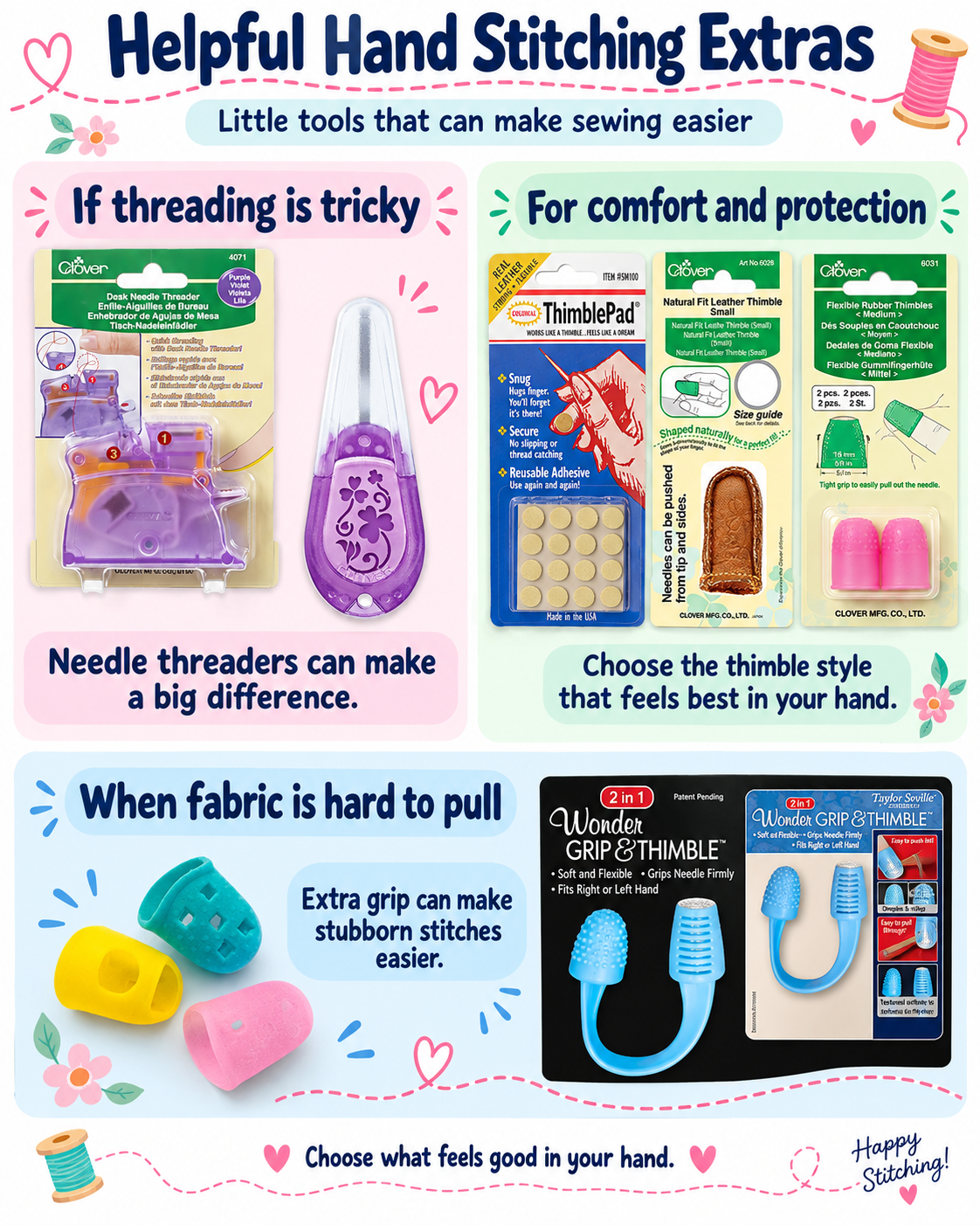
Things that may help:
- a slightly longer needle
- a slightly shorter needle
- a larger eye
- self-threading needles
- a needle threader
- a thicker shaft that's easier to hold
- a thimble
- a needle puller when fabric becomes difficult
And so importantly:
- Don't keep struggling simply because the packet says that's the size you're “supposed” to use.
- If arthritis, reduced grip, eyesight or simply personal preference makes another needle more comfortable, use it.
THE BIG ONE — WHEN IS YOUR NEEDLE'S TIME UP?
There isn't a magic number of hours.
Hand needles wear differently depending on:
- fabric
- thread
- number of layers
- how firmly we stitch
- moisture from our hands
- the needle's finish
- how it has been stored
Look for these signs:
- It doesn't glide anymore
- You find yourself pushing harder or tugging it through fabric that was previously easy.
- A good needle should move cleanly; sashiko guidance likewise recommends retiring a needle when it stops moving cleanly rather than forcing it.
- The point feels dull or catches
- It may start snagging fibres rather than entering cleanly.
- You might not even be able to see the damage.
- It has developed a bend
This one is important:
- Don't straighten it and carry on.
- A bent shaft changes the way the needle travels through the fabric and places extra stress on it. Guidance for sashiko needles similarly recommends replacing a bent needle rather than continuing to use it.
Your thread suddenly starts fraying
- Especially near the eye.
- The inside edge of an eye can become damaged or rough. If thread that normally behaves beautifully suddenly starts fluffing or breaking, inspect the needle before blaming the thread.
You can see rust, tarnish or roughness
- Retire it.
- Don't risk transferring rust or rough marks to your beautiful fabric.
Your hand is working harder
- If your fingers, wrist or shoulder seem to be doing more work to get each stitch through, try a fresh needle.
- Sometimes we adjust gradually to a worn tool without realising how much harder we're working.
THE FRESH NEEDLE TEST
If you're not sure whether the old needle is worn out:
Thread a brand-new one of the same type.
Take ten stitches.
If you immediately think,
“Ohhhh… that's better.”
Your old needle has answered the question.
DON'T THROW OLD NEEDLES LOOSE IN THE BIN
Tiny practical safety idea -
- Have a little rigid container or old lidded jar/tin specifically for spent needles.
- When it's full, close it securely before disposal according to your local waste requirements.
BUT ALSO:
- Don't put worn needles back amongst the good ones.
- Otherwise three months later you're sitting there wondering which of the fourteen identical needles is the horrible one. 😂
LOOK AFTER THE GOOD ONES
Simple care:
- keep them dry
- don't leave them somewhere damp
- return specialty needles to their packet/tube if possible
- use a needle minder while working
- don't mix damaged needles back in with fresh ones
- keep different types labelled if you can't easily recognise them
https://everythingfabric.com.au/collections/hand-sewing-needles
There is a lot more to a needle isn't there!
There are beautiful specialist needles, wonderful premium needles and very good everyday needles — and there's room in the sewing basket for all of them.
Try different lengths. Try different sizes. Try a larger eye if threading is making you cranky.
And if the needle you've used faithfully for goodness-knows-how-many projects suddenly starts making sewing feel like hard work, perhaps it has earned retirement.
A new needle is a very small change.
But your hands might notice a very big difference.
What Do You Think?
Do you have a favourite hand-sewing needle, or a tip that makes stitching easier? I’d love to hear your thoughts, experiences and questions.
Share a comment below, and let me know which sewing tool, technique or topic you’d like me to explore next. Please use your first and last name when commenting.
If you’d prefer to reply privately, email Carrie with your feedback or suggestions.
Happy stitching,
Carrie